Recovery
Plastic and Cosmetic Surgery
Medical Tourism
Plastic Surgery Recovery Timeline: A Complete Week-by-Week Guide
Discover practical recovery advice, expert tips, and inspiration to help you make the most of your post-op procedure in Guadalajara.
Plastic Surgery Recovery Timeline: A Complete Week-by-Week Guide
Most people search for "how long does plastic surgery recovery take" hoping for a single number. The honest answer is more useful than that. Surface healing usually takes 4 to 6 weeks. Internal tissue remodeling continues for up to a year, and that timeline shifts based on your procedure, your health, and the environment where you recover (NCBI, Wound Healing Phases).
This guide walks through what happens in your body week by week, what is normal, what is not, and what the research actually says about helping recovery go well.
Key Takeaways
Wound healing happens in four overlapping phases: hemostasis, inflammation (days 1-3), proliferation (days 4-21), and remodeling (day 21 through over a year) (NCBI).
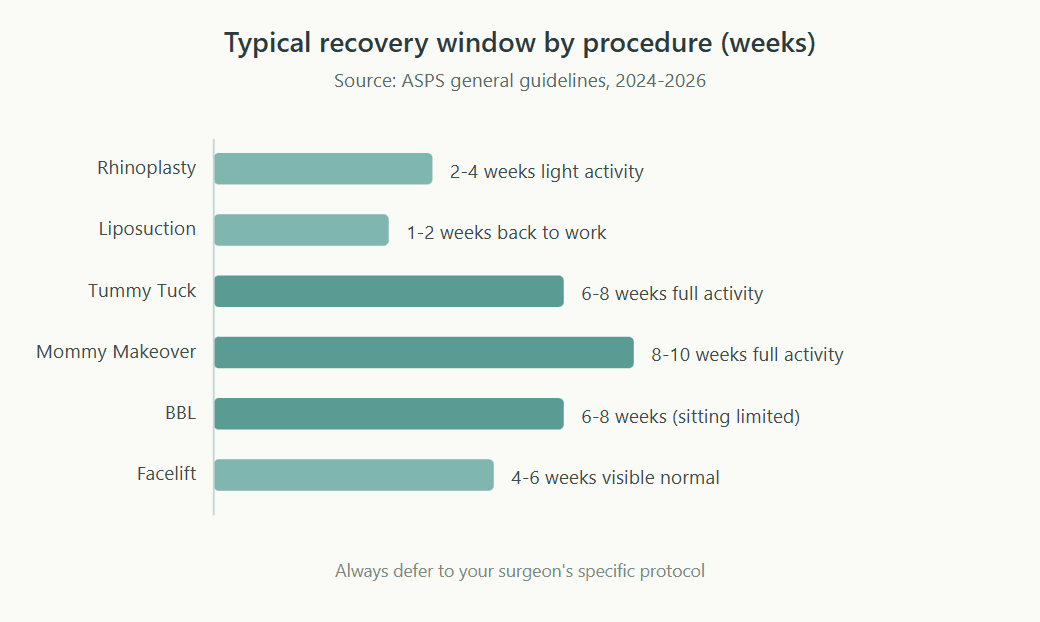
Most patients return to desk work between 1 and 2 weeks for procedures like a tummy tuck, with 6 to 8 weeks for full activity (ASPS).
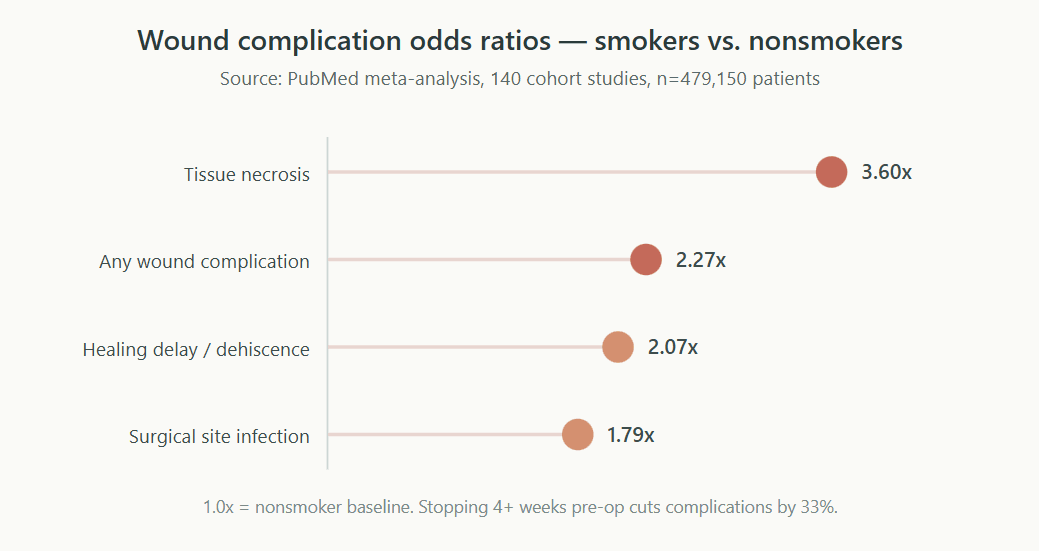
Smoking raises wound complication risk by an adjusted odds ratio of 2.27, and stopping at least 4 weeks before surgery cuts complications by 33% (PubMed).
The Four Phases of Wound Healing
Wound healing follows four precisely programmed phases that shape every recovery timeline (NCBI StatPearls). Hemostasis stops the bleeding within minutes. Inflammation runs days 1 to 3. Proliferation, when new tissue actively forms, runs days 4 to 21. Remodeling, when that tissue strengthens and matures, runs from day 21 onward and can continue for a year or more.
Most people only experience these phases as "swelling," "tightness," and "this is taking forever." Knowing the underlying biology helps. It explains why you feel terrible at day 3, noticeably better at day 10, almost normal at six weeks, and yet still see small changes at month 6.
Hemostasis and Inflammation (Days 1-3)
Vasoconstriction and platelet aggregation stop bleeding within minutes after surgery. Inflammation then takes over for 1 to 3 days, marked by increased vascular activity (NCBI). This is why everything feels swollen and warm. Inflammation is doing its job, even when it feels like the opposite of healing.
Proliferation (Days 4-21)
The proliferative phase produces granulation tissue, new blood vessels, and the early closure of the wound surface. By the end of week 3, most patients feel meaningfully different from how they felt in week 1, though they are still nowhere near final results.
Remodeling (Day 21 Through Year 1)
Remodeling is the long quiet phase. Collagen fibers reorganize. Scars soften and fade. Maximum tissue strength develops over months, not weeks. Patience here is not a personality trait — it is biology.
Week 1: The Critical Recovery Window
Week 1 is the most physically demanding stretch of recovery. Pain is at its highest, swelling is peaking, and your body is using significant energy on inflammation (NCBI). Most surgeons schedule the first follow-up appointment within this window because complications, when they happen, usually appear in the first 7 days.

Days 1-3: Acute Recovery
Pain is managed through prescribed medication. Drains may be in place depending on the procedure. Movement is limited to short walks to encourage circulation and reduce the risk of blood clots. Sleep is interrupted. Appetite is often poor. None of this is unusual.
Days 4-7: Inflammation Peaks Then Eases
Bruising spreads before it fades, which alarms most patients. Swelling is at its highest around days 3 to 5 and begins to ease by day 7. Light walking around the home becomes more comfortable. Showering rules vary by procedure and surgeon.
Warning Signs That Need Immediate Medical Attention
Call your surgeon right away if you experience any of these:
Fever above 101°F (38.3°C)
Sudden increase in pain not controlled by your medication
Heavy bleeding from incisions
Foul-smelling drainage
Sudden swelling or pain in one calf
Shortness of breath
These are not waiting-room symptoms. They are time-sensitive.
Week 2: Out of Acute Recovery
By the start of week 2, most patients feel a meaningful shift. Pain is lower, mobility is returning, and the proliferation phase is actively rebuilding tissue (NCBI). The American Society of Plastic Surgeons notes that some tummy tuck patients can return to light desk work and daily activities by this point, with surgeon approval (ASPS).
Drains are often removed in week 2. Sutures may come out, depending on the procedure and technique. Driving is usually still off the table because reaction time is impaired by lingering medication and limited mobility.
What You Can and Cannot Do Yet
Sitting upright for short periods is fine for most procedures. Light walking is encouraged. Lifting anything heavier than a gallon of milk is not. Bending, twisting, and reaching overhead are restricted depending on your procedure and surgeon. The temptation to do "just a little more than yesterday" is the leading cause of week 2 setbacks.
Weeks 3-4: Returning to Light Activity
Weeks 3 and 4 mark the return to a recognizable daily rhythm for most patients. Swelling continues to drop, energy improves, and the proliferative phase peaks (NCBI). For tummy tuck patients, the ASPS notes that most can resume usual activities by week 4 with surgeon approval (ASPS).
For Brazilian Butt Lift (BBL) patients, sitting restrictions ease into specialized BBL pillow use, which redistributes pressure away from transferred fat cells. Sitting completely on the buttocks remains restricted for the full 6 to 8 week window (ASPS).
What still needs restriction in this window: structured exercise, lifting over 10 to 15 pounds, sleeping in non-recommended positions, and any activity that strains the surgical area. Compression garments are typically worn throughout this period.
Weeks 5-6: Late Recovery Milestones
By weeks 5 and 6, most surface healing is complete. Scars begin to mature, fading from red to pink. The remodeling phase is now active, building strength in the new tissue (NCBI). Most procedural restrictions lift around this point with surgeon approval.
Tummy tuck patients are typically cleared for more strenuous exercise around week 6 (ASPS). BBL patients can usually return to normal sitting patterns (ASPS). Final results are still not visible. Residual swelling in the deep tissues continues to settle, sometimes for months.
Months 2-6: The Invisible Recovery Phase
Most patients underestimate how long the final phase takes. Tissue remodeling can continue for a year or more after surgery (NCBI). Residual swelling resolves slowly. Scars continue to lighten and flatten. Deep contour and final shape often only emerge between months 3 and 6.
This is also when patients are most likely to feel discouraged, because the dramatic week-to-week changes of the first month are over. Progress is now measured in subtle improvements visible in side-by-side photos taken weeks apart.
Factors That Shape Your Personal Timeline
The textbook timeline is a useful baseline, but several research-backed factors shift it meaningfully in either direction. The biggest single modifiable factor is usually whether the patient smokes (PubMed).
Smoking and Wound Healing
A meta-analysis pooling 140 cohort studies and 479,150 patients found that smokers had an adjusted odds ratio of 3.60 for tissue necrosis, 2.07 for healing delay and dehiscence, and 1.79 for surgical site infection compared with nonsmokers (PubMed).
The good news is that these risks are reversible. Stopping smoking at least 4 weeks before surgery was associated with a 33% lower risk of wound complications and a 14% lower mortality rate in a meta-analysis of randomized trials (PubMed).
Protein and Nutrition
Wound healing is metabolically expensive. Current clinical recommendations call for 1.2 to 2.0 grams of protein per kilogram of body weight per day in the weeks leading up to surgery, and approximately 1.5 g/kg/day during active wound healing (Mount Sinai). For a 70 kg patient, that is roughly 105 grams of protein per day.
A controlled study of abdominoplasty patients found that those receiving early protein supplementation had wound dehiscence rates of 6% versus 17% in the control group, and a complete healing time of 16.8 days versus 20.5 days (Aesthetic Plastic Surgery, Springer).
Age, Health, and Recovery Environment
Older patients heal more slowly because the proliferation and remodeling phases are less efficient. Diabetes, anemia, and uncontrolled chronic conditions all extend timelines and raise complication risk. The recovery environment — including monitoring, cleanliness, and consistency of care — also has a measurable impact.
Recovery Red Flags: When to Call Your Surgeon
The body usually signals problems clearly when they exist. The five highest-priority warning signs after plastic surgery are recognizable without medical training.
Call your surgeon, or seek emergency care, if you experience any of the following: a fever above 101°F (38.3°C), sudden severe pain not controlled by your prescribed medication, heavy bleeding through dressings, sudden swelling or pain in one calf, or shortness of breath. These can indicate infection, internal bleeding, deep vein thrombosis, or pulmonary embolism.
This article is for educational purposes only and does not replace medical advice from your surgical team.
What Helps Recovery Go Smoother
A handful of evidence-based interventions consistently shorten recovery and reduce complications. These are not shortcuts. They are the basics, and most patients underuse them.

Nutrition
Protein intake at 1.2 to 2.0 g/kg/day before surgery and approximately 1.5 g/kg/day during recovery is associated with measurably faster healing and fewer complications (Mount Sinai). Arginine and glutamine have been shown to reduce surgical site infections and shorten recovery time (PMC).
Sleep and Positioning
Sleep is when most tissue repair happens. Following your surgeon's specific positioning instructions — including wedge pillows or recliners where indicated — is one of the highest-impact things you can do in the first two weeks.
Movement
Early gentle walking, starting in days 1 to 2, reduces the risk of blood clots without straining the surgical site. Movement should be incremental. Doing too much in week 2 is a leading cause of week 3 setbacks.
Where You Recover
The environment where you spend the first 7 to 14 days matters. Adequate monitoring, accessible nursing care, proper nutrition, and someone trained to watch for warning signs can be the difference between catching a complication early and missing it.
Frequently Asked Questions
How long does plastic surgery recovery take in total?
Surface healing typically completes in 4 to 6 weeks for most procedures. Internal tissue remodeling continues for up to a year, meaning subtle changes in scar appearance and contour keep happening for months (NCBI). Final results are usually visible between 3 and 6 months.
What is the hardest week of recovery?
Week 1 is the most physically demanding for most patients. Pain peaks in the first 3 days, swelling peaks around days 3 to 5, and sleep is usually poor. Most surgeons schedule their first follow-up within this window because complications, when they occur, typically appear here.
Is it safe to recover alone at home?
The first 24 to 72 hours after most plastic surgery procedures benefit from someone present to assist with mobility, medication, and watching for warning signs like fever or excessive bleeding. Recovering alone in an unfamiliar environment increases the risk of missed complications.
When can I fly after plastic surgery?
Most surgeons recommend waiting at least 5 to 7 days after outpatient procedures before flying, with longer windows for major procedures or if drains are still in place. Long flights raise the risk of deep vein thrombosis. Always confirm with your surgeon.
How soon can I exercise?
Light walking begins in days 1 to 2 to reduce blood clot risk. Structured exercise is typically restricted for at least 4 to 6 weeks, with full return to strenuous activity often around week 6 to 8 (ASPS). Restarting too early is one of the leading causes of setbacks.
What should I eat during recovery?
Aim for 1.2 to 2.0 grams of protein per kilogram of body weight per day before surgery and approximately 1.5 g/kg/day during active healing (Mount Sinai). Hydration, vitamin C, zinc, and arginine-rich foods support wound healing. Alcohol and highly processed foods slow it.
When will I see final results?
Most patients see a recognizable result by week 6 and a near-final result around month 3. Subtle changes in scar maturation and contour continue through month 6 and sometimes longer (NCBI). Side-by-side photos taken weeks apart are the easiest way to track progress.
Innova Recovery is a post-surgical recovery facility in Guadalajara, Mexico — not a medical clinic. This article is for educational purposes only. Always follow your surgeon's specific instructions.


